

Saying you use AI in engineering in 2026 is like saying you use the internet. It tells you almost nothing.
Meanwhile, teams are making real decisions about hiring, workflow, growth, and performance using language that hasn't caught up with how the work has actually changed. What's missing is a shared way to talk about how engineers actually work with AI, not just that they do.
So OfferZen built one. The AI Engineering Archetypes quiz gives tech teams exactly that. Think of it as a Sorting Hat for your engineering team: run it across the team and the invisible becomes visible: where you're concentrated, where the gaps are, and where to go next.
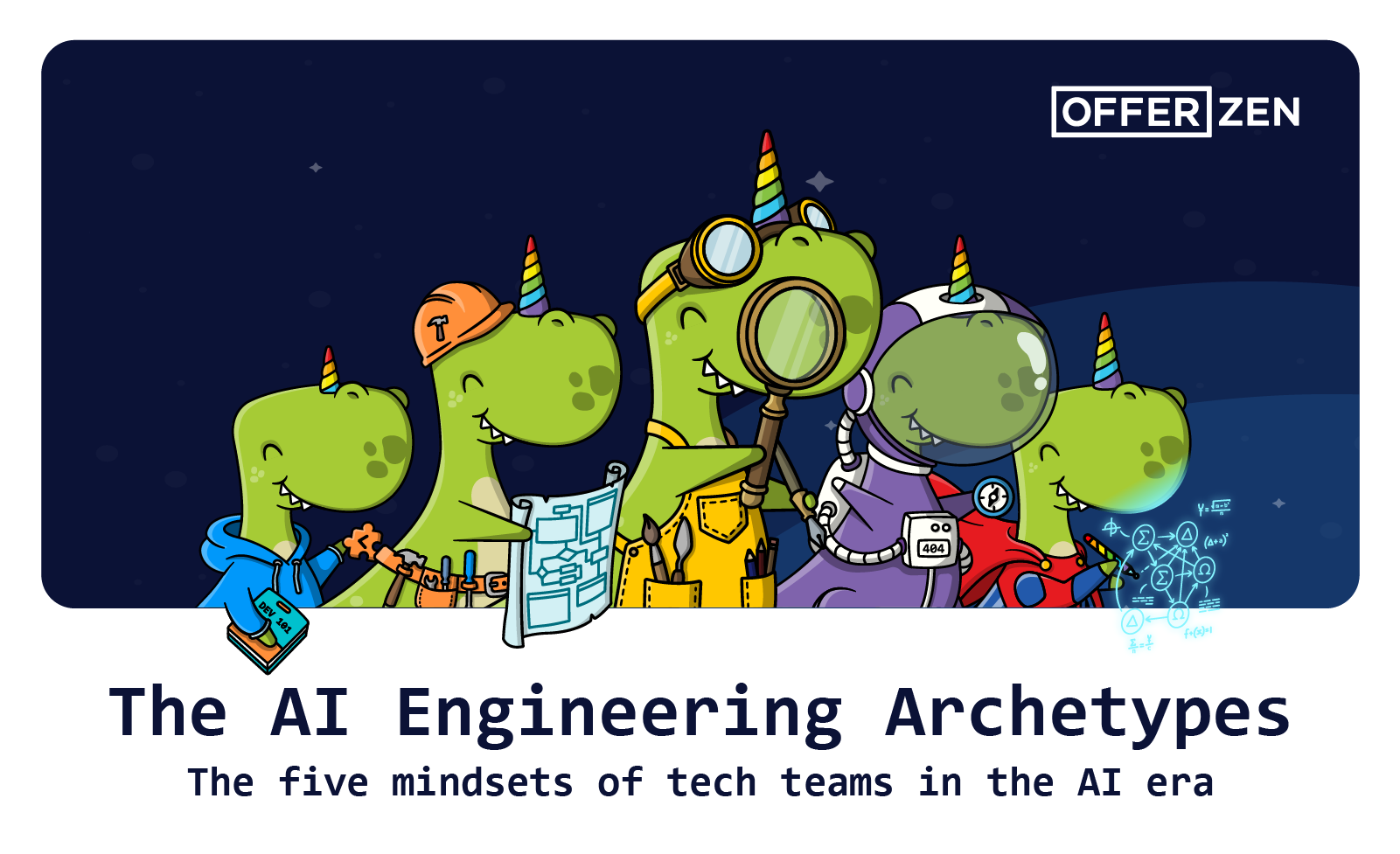
OfferZen's 5 AI engineering archetypes
- The Multiplier: Thinking partner to AI. Builds the guardrails and patterns that let the whole team ship faster.
- The Builder: Treats AI as an execution engine. Operates one level up from code, steering agents rather than writing syntax.
- The Explorer: Reads systems from the outside in. Uses AI to answer their own questions about the codebase instead of pulling other people off product work.
- The Artisan: Leads AI moment-to-moment because default output isn't good enough in their area of depth. Stays close to the code and catches drift early.
- The Apprentice: Co-creates with AI through dialogue. Builds judgement one prompt at a time, and ships only what they can defend.
Each one captures a distinct mindset, a set of typical behaviours, and the kind of work the archetype is built to do well.
How the archetypes came to life
OfferZen's engineering team runs regular discussions to build shared AI standards across the team and dig into software engineering topics together. Across these, everyone showcased how they were using AI, and the approaches were completely different.
Jason Tame, tech lead at OfferZen, was the one who recognised that gap for what it was. It's no coincidence. Jason started his career in education before moving into software development, and has spent years mentoring junior devs and people breaking into the industry. Spotting patterns and making knowledge transferable is second nature to him.
What if these weren't just personal preferences, but distinct mindsets that could be named and learned from? He spent time mapping the patterns across those sessions, and the five archetypes came out of that work.
How to think about your archetype
Your archetype is a read on how you work with AI right now, not a permanent label. Archetypes shift as the work shifts. As the codebase shifts. As your own taste develops. Today's Apprentice is next year's Builder. A Builder on a greenfield system might be an Artisan on legacy code the following week.
Watch five engineers on the same team for a week and you'll see why. One reviews every diff line by line. Another steers agents through parallel features. A third hasn't written a line of code all day and is somehow the reason everyone else can. Same team, same tools, very different work.
What engineers get out of this
If you're an individual contributor in a tech team, the quiz answers the question most ICs struggle to answer: how am I actually working with AI, and what does growth look like from here? You get actual direction instead of "use AI more."
Knowing your archetype gives you:
- A clear picture of how your archetype works at its best, the blind spots that come with it, and which behaviours to lean into. Every strength has a shadow side, and in an AI-augmented workflow, blind spots compound faster than they used to.
- The mindset shift that separates your archetype from the next one and what growth actually looks like from where you are. As AI changes what engineering work is, knowing where to grow next matters more than ever.
What engineering leaders get out of this
If you're leading a tech team, the archetypes become a team map. Run the quiz across your engineers and you'll see the real shape of how your team works with AI. Every team has an implicit archetype mix, whether you designed it or not. Making that mix visible changes the conversation from "are people using AI enough?" to much sharper questions:
- If everyone is a Builder, who's building the guardrails that keep quality from drifting?
- If you have no Multipliers, who's creating the patterns that let the team scale without adding headcount?
- If your junior Apprentices have no Builders nearby, who's reviewing their work?
- If your Explorers can't get answers from the codebase without pulling a developer, what does that say about how the system is set up?
Do I need all five archetypes on my team?
Not necessarily, and team size matters here. A two-person startup probably doesn't need a dedicated Explorer, though a non-technical co-founder enabled by a good Multiplier might naturally become one. A ten-person team without a Multiplier might not feel the gap until the codebase gets complex enough that AI starts causing more problems than it solves.
The more useful question is: which archetypes are missing, and what does that cost you right now? A team of Builders ships fast but accumulates drift. A team of Artisans produces quality work but struggles with velocity. A team of Apprentices with no senior archetype nearby is learning in a vacuum.
The framework is a diagnostic, not a hiring checklist. Run it, see your mix, and figure out what kind of work is not getting the attention it needs.
Take the quiz
Find your archetype, or run it across your entire engineering team. It'll place you in one of the five archetypes and point at the next one worth growing toward.
The quiz only takes five minutes. Take the quiz