We chatted with Brian van Vuuren, Software Development Manager at Allan Gray, about how AI is changing the way we build software. Brian shared the sentiment that while AI can help teams move faster, it doesn't necessarily lighten the load they carry. And, for engineering leaders, it provides a nice opportunity to dive back into the technical detail.
Ask Brian what he's thinking as his teams are adopting AI, and he talks about a backpack.
"You wear a backpack as a company. And with everything you build, you put another stone in that backpack. A stone you keep carrying as long as that piece of software is live."
AI, he reckons, "has the potential to create a boulder out of something that should be a brick."
It's a fitting metaphor for how Brian thinks about engineering. While everyone else is talking about how AI helps developers move faster, he's more interested in what comes next – after the code is shipped.
Getting something to work is one thing. Building something you can actually maintain, scale, and build on top of? That's a whole different ball game.
Brian manages tech leads across different parts of the company's technical estate. After nearly nine years at Allan Gray – starting out as a developer himself – he doesn't see AI as a replacement for what makes a good engineer, but rather as a way to amplify the traits an engineer already embodies.
If you're thorough, curious and willing to understand a problem properly, AI offers the potential to make you even better at those things. But if you're looking for hacks, quick fixes, or shortcuts – AI will amplify (and eventually expose) that too.
The systems problem that led him into leadership
Brian's path into software wasn't exactly textbook. He joined Allan Gray as a developer without a Computer Science degree, picking up most of his skills 'on the job'. Before that, he'd earned a PhD in Industrial Engineering and Operations Research at Stellenbosch University, and spent two years lecturing in the Engineering faculty.
So, when he landed on the software floor, he was already trained to think in systems.
He also knew where he stood as a coder. Some teammates had been programming since they could reach a keyboard, and honestly, they were better at it.
"There were (and still are) a lot of really smart people at Allan Gray," he says.
But the real puzzle was what happened when you put all those smart people together: how they worked, how they fit, how they actually got things done.
"It's a systems problem," he says. "It's just a people-systems problem."
That's where Brian saw his chance to make an impact. He started by leading a team, then moved on to managing teams more broadly, always focused on helping technical people do their best work and grow their own careers.
He brings that same systems mindset to AI.
Every release adds another stone to the backpack
"I tend to worry less about go-live day, and I worry more about the day thereafter."
Brian's questions come after delivery. What happens if someone leaves? What happens if something breaks? Can anyone actually debug it? Do we understand what it is doing? Will it scale?
The faster a team builds, the easier it becomes to keep tossing things into the backpack without stopping to think about how heavy the load gets.
"There's massive potential to bring AI into what we're doing, but I believe we need to think about it slightly differently. If you're just throwing AI into the mix to try and get things done faster, then I think you're missing the point."
For Brian, that's where one of the biggest misconceptions about AI begins: getting something done and getting something right aren't necessarily the same thing.
Before you hand it to AI, start with the four Ds
"If you don't understand the connection between requirement and the outcome, you'll never know just how well or badly you solved the problem."
That's why he adopts the four Ds, borrowed from Anthropic's AI Fluency framework.
Delegation comes before you type anything. Should this even be an AI function in the first place?
Description is how well you say what you want. Prompting an LLM for an answer is the easy version. Learning "to actually build the context and harnesses" is where the longer-term gains sit.
Diligence means thinking about the use case, context, and security. All the things, as Brian puts it, "the classic vibe coder wouldn't even be aware of."
And then there's Discernment: can you (and do you) actually judge the quality of what AI gives you? That's the one that concerns him most about the next generation of developers.
Juniors have to build the judgement AI can't hand them
Brian admits to having learned mostly by pattern matching. He'd read code, work out what it did, copy over config from other files, and tweak what needed changing to solve a problem. Then came the harder question: could he build it from scratch?
"And the answer, at the time, was no. I realised I needed to invest in the learning."
Now, AI gives you something close to a 'model answer' right away. If your goal is just to get a task done, it's tempting to take the answer at face value and move on.
But Brian isn't losing sleep over juniors using AI tools - he's more interested in whether they're building the judgement to notice when the response they get doesn't quite 'fit'.
This responsibility doesn't sit with juniors alone either. High-quality code reviews, invested mentorship, and senior engineers asking the tough questions have all become increasingly important aspects of delivering quality software.
That's also why, no matter how advanced AI gets, the quality Brian values most is agency: "the ability to figure out what needs to be done and doing it, rather than waiting to be told."
AI can do many things for you, but it can't teach you to think critically. That's a skill you must develop for yourself through experience, practice, and repetition. Having agency puts you in a position where not only can you do the work, but you can figure out what work is worth doing in the first place.
Brian worries that people tend lose this instinct at university, where you often just follow instructions to pass exams and get through courses. The developers who stand out are those who stop waiting for instructions and learn to take initiative.
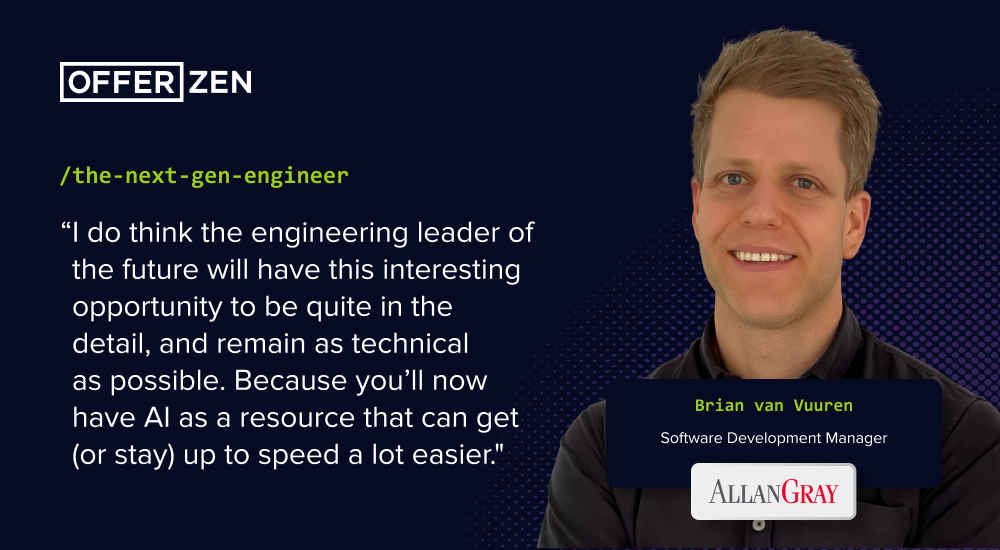
AI opens the door for leaders to dive back into the details
AI challenges a classic management problem: the more teams you manage, the further you drift from the work. Brian thinks AI gives leaders a way back in.
It can synthesise information, get you up to speed, and help you stay technical enough to ask better questions about the work, without having to dig through every line of code yourself.
"You don't really have an excuse anymore to say it's too much."
And that matters. In OfferZen's 2026 Salary and Benefits Report, 79% of tech leads said trust in a manager comes from them understanding what they actually do day to day.
That doesn't mean managers necessarily need to start coding full-time again. Brian cares less about who ships the most code or uses AI the quickest, and more about how his people are developing, thinking and growing.
At the end of the day, my job is still about understanding my people: what challenges they are facing, what priorities they are balancing, and where they want to go in their careers. It's tough to do this well if you have no functional understanding or context of the kind of work they do and problems they tackle (technical or otherwise) every day.
For Brian, even though AI helps do things better at scale, the true essence of being a people manager still comes down to caring for the individual. "If I can do something that benefits 50 people, then that's great. But if the work I do and the investment I make only ever helps or impacts one person, it's still worth doing. That's the basis of authentic people leadership."
And in a world seemingly obsessed with doing more and more things faster and faster for greater and greater impact, Brian believes it's important we don't lose sight of the fact that "people still remain people."
His advice: go and rumble with it
For any leader still on the fence about adopting AI, Brian's advice is simple: "Go and rumble with it a bit and see for yourself what it can and can't do."
You've got to burn your fingers - try things, get yourself into a few holes, see the mistakes AI makes, and understand where the benefits lie and the pitfalls hide.
That way, you'll likely feel a lot more comfortable carrying even the heaviest backpack, with confidence and conviction about exactly what you chose to put in it.