We spoke to Sameer Adams, Head of Software & AI Engineering at Coronation Fund Managers, about how 13 years at the company has shaped his approach to AI. He kept coming back to two things the tools haven't changed: engineers own what they ship, and the people worth hiring are the ones who can work through a problem.
80 people, one principle: if you build it, you support it
Sameer joined Coronation 13 years ago to lead a digital transformation project as part of a small technology department of around 10 people.
Today, the Information Systems department has grown to around 80 people. Sameer calls it "a very organic change": the team grew as the business needed new capabilities.
In a more conventional organisation, his role would sit closer to a CTO's than a CIO's. The Group Head sets the strategy, and Sameer executes it. He makes sure the right tools, engineering standards, and patterns are in place, and that the team delivers on the plan.
He's held on to one principle through every stage of that growth: if you build it, you support it. AI has only made it more important.
Human oversight stays in the loop
When Sameer talks about what AI has changed at Coronation, he starts with oversight: "There's a lot more guardrails in place because it's so easy for things to go wrong."
Coronation rolled out AI across the company with one rule: if AI played a part in anything involving data or decision-making, you have to say so.
In engineering, that oversight is built into the process itself:
- An orchestrator receives the request.
- It hands off to specialised agents, including an architect agent that sketches out a build plan.
- A human reviews the plan and asks for amendments.
- Once the amendments are done, the sign-off gets recorded.
- The orchestrator only lets the plan move to implementation after that sign-off.
- During implementation, the human in the loop reviews the changes, the standards and the tests.
The process keeps changing. Teams are always experimenting with new agents and skills, and every second week they demo what's working to the Dev Centre of Excellence (DevCoE).
The DevCoE decides whether to roll each one out, tighten the rules around it, or drop it. The whole department also meets every two weeks to share what they've learnt.
The bottleneck was never engineering
Sameer takes the same approach to new ways of working as he does to AI: test it before you trust it. At Coronation, they've tried several popular team structures, including the small-squads model used at Meta.
They'd hand a new working model to a team, let them use it for a few sprints, then listen to their feedback. Sometimes it created knowledge silos. Other times, it needed more cross-team coordination than the project called for. None of the models they tried worked as a standard across teams, so they adapted their processes to enable agentic work.
The experiments did show him where the bottleneck is. It sits upstream of engineering, with stakeholders, design choices, analysis and what Sameer calls "the periphery". That's where uncertainty builds, before an engineer has touched an agent.
So he has little patience for the idea that you can type a sentence into a model and get a finished system back. "It's not going to work at Coronation. AI can build it, but do not expect it to meet any enterprise-grade standards."
That's why the early stages of a project still go into building infrastructure. Once that's in place, AI starts to speed things up.
AI changes the tools, not the fundamentals
Some people worry that engineers will lose their judgement if they stop writing every line of code themselves. Sameer answers that from his own career.
He started coding in the early days of .NET and object-oriented programming, when structure, encapsulation and objects changed how software was built. He sees this moment as a similar shift. "Where we are right now is just an adaptation of where we should be."
His expectations of engineers are the same as they were then. They need to understand what the code does and why. When something goes wrong, saying "AI built this" isn't an answer Coronation accepts.
Some of those standards now live in the tools. Issues that used to be caught in code review are now built into the agents and skills engineers use.
When it comes to measuring AI, Sameer has resisted pressure to report productivity percentages. The one metric he stands by is quality: software that breaks less often and gets fixed faster when it does.
Hiring now comes down to how someone thinks
Sameer is blunt about what he looks for now: "If you're not using AI, I won't be interested." The tools are easy to pick up, often, a short video is enough to learn the basics of a tool like Claude Code, so he sees no excuse. AI fluency is what separates candidates who look identical on paper.
It's only the starting point, though. What decides who gets hired is how someone works through a problem, and how quickly they learn.
OfferZen's 2026 State of SA's Developer Nation report found that juniors are the most likely to say they're underpaid: 62%, the highest of any experience band. At the same time, AI is taking on the routine work that used to build their skills.
While entry points for juniors are shrinking elsewhere, Coronation has run a decade-long augmentation partnership that rotates graduates through the department under senior mentors.
A 20-year-old, a 25-year-old and a 30-year-old all learn differently, Sameer says, so mentoring them also pushes his senior engineers. They get almost as much out of it as the graduates do.
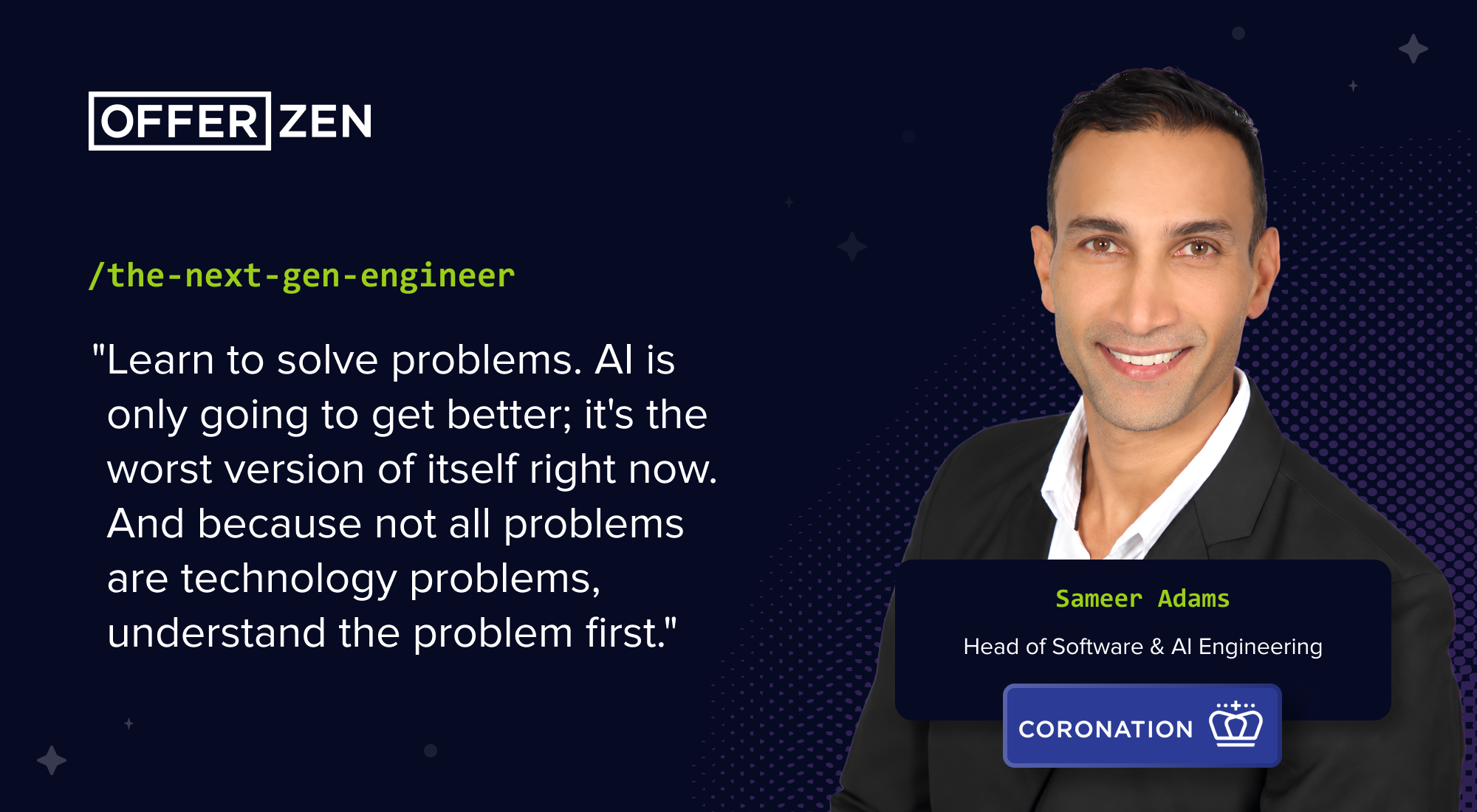
He gives his own kids the same advice: "Learn to solve problems. AI is only going to get better. It's the worst version of itself right now. And because not all problems are technology problems, understand the problem first."