
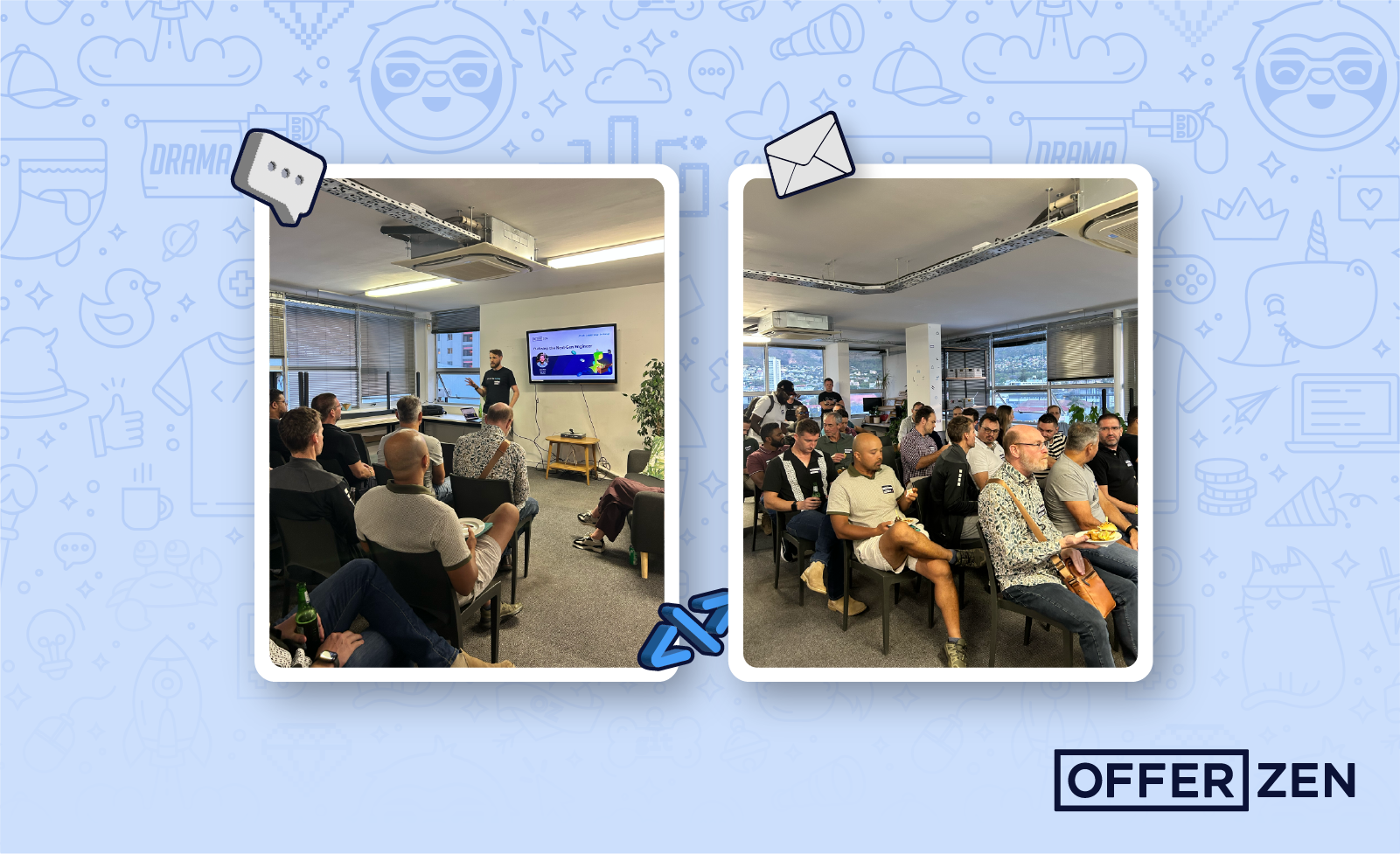
We hosted our second Tech Leader Exchange, bringing 30+ tech leaders together at the OfferZen office. With 95% of South African tech teams already using AI, the question is no longer whether to adopt AI. It's whether the engineers we’ve been hiring are still the right fit for what comes next.
Across four roundtable discussions, CTOs, tech leads, and engineering managers from some of SA's biggest and most innovative companies sat down to wrestle with one deceptively simple question: what does the next-gen engineer actually look like?
The answer, it turns out, isn't a better coder. As one participant put it: "The coding language of the future is English. If you can't explain it to me, how are you going to explain it to the AI?”
What Is a Next-Gen Engineer?
A next-gen engineer is no longer defined purely by their ability to write code. They are product-minded, business-aware, and able to collaborate across disciplines that were previously siloed.
As one tech leader put it: "We're not going to be software developers anymore. We're going to be product developers. We're developing products, not developing software."
What Are the Key Traits of a Next-Gen Engineer?
So, what actually makes a next-gen engineer? With AI now part of every developer’s workflow, these are the 6 traits tech leaders look for.
1. Curiosity
Curiosity was the single most mentioned trait across every table. Leaders were quick to clarify that this extends beyond technology to the business, the customer, and the problem being solved. As one leader put it: "You can't just sit in a back room and spit out code. You need to be curious about what the business is trying to achieve."
And from another leader: "We've always hired for curiosity about tech, but now we need to be curious about more than tech. What is the business trying to achieve, what problems are they trying to solve?"
2. Adaptability
With tools and roles changing faster than ever, adaptability was seen as non-negotiable. Engineers with broader interests and identities outside of coding are adapting faster than those who have built their entire professional identity around writing code.
As one leader observed: "The programmer who is also a photographer is adapting quicker than the programmer whose whole identity is programming."
3. Communication
Multiple leaders flagged communication as the trait they're now hiring hardest for. The ability to clearly articulate a problem to a stakeholder, a client, or an AI is becoming as important as any technical skill.
One manager shared how they assess this in hiring: "I give you a loosely defined task – a start and an end – and everything in between is where you get to impress. How you communicate is the whole thing."
4. Product Mindedness
The next-gen engineer understands the value they're delivering, not just the code they're shipping. They interface with customers, understand business decisions, and take ownership of outcomes rather than tasks.
As one CTO put it: "Your future as an engineer is going to be tied to the fact that you can sell why the thing you create is valuable."
5. Systems Thinking
Leaders want engineers who can see how everything connects across architecture, infrastructure, business logic, and customer impact rather than optimising only for their specific layer.
One leader summed it up: "You need to understand architecture, what our business requires, and how to put all of that together. That's what the next-gen engineer looks like."
6. Self-Direction
The ability to handle ambiguity, navigate problems independently, and know when to escalate was raised repeatedly. One engineering leader made it a measurable expectation: "If you're working on anything for more than an hour, you need to flag it to your team lead. We actually track that, it's a KPI in performance reviews."
Is Technical Mastery Still Important for Engineers?
Does syntax still matter or are we moving past it? In the room, opinions split. Some leaders doubled down on foundational knowledge. Others argued the craft is evolving, with debugging moving up the abstraction layer.
The case for keeping foundations strong
Foundational technical knowledge still really matters, especially for spotting when AI gets things wrong.
One leader who started out with C and Fortran put it simply: “The difference shows up when there’s an error. I can usually guess what went wrong. Others have to prompt their way through it. You don’t always have that instinct that something’s off.”
The case for moving up the abstraction layer
Others in the room pushed back on the idea that deep technical knowledge is still essential. Their argument: every generation of engineers has had to debug at a different layer, and this is just the next shift. When developers moved from C to Python, they stopped worrying about memory management and started debugging logic instead. The same thing is happening now.
As one leader put it: "When you abstract up, you might get really good at recognising hallucination in a model. That will become the key debugging skill." The craft isn't disappearing. It's moving up a level.
Where the room landed
There was broad agreement that the answer is domain and context specific. Legacy systems, regulated industries, and complex infrastructure still demand deep technical understanding. For newer, more product-focused environments, the abstraction layers may be enough.
As one leader summarised: "You need to continuously evaluate your level of confidence in what AI has done for you. It's risk and severity the whole time. What is the risk of this being wrong, and what is the severity if it goes wrong?"
How Are Companies Identifying These Traits When Hiring?
Traditional hiring filters like degree, university, years of experience came up repeatedly as unreliable proxies for the traits leaders actually care about.
The conversation across all four roundtables kept coming back to the same challenge: CVs all look the same, and coding tests no longer tell you what you need to know.
Why traditional coding tests are becoming unreliable
With AI able to complete most standard assessments, testing for syntax and technical output is no longer a meaningful signal. Leaders are shifting toward assessing how candidates think and communicate. As one participant put it: "We encourage the use of AI in our assessments, and then ask them: where did you use it? How did you decide what to trust? That tells you far more about their problem-solving philosophy than the code itself."
What leaders are looking for instead
Side projects, personal builds, and evidence of self-directed learning came up consistently as stronger signals than formal qualifications.
One leader shared his approach: "The biggest thing for me is to see what you're doing outside of work. If you're spending time reading, figuring things out, building your own projects I'm interested in talking to you." Another noted that a candidate who built a water pump system for his community stood out more than any CV he reviewed that day.
At OfferZen, we're building for next-gen engineering teams. Candidate profiles now include an AI fluency section and a dedicated projects section so you can see what engineers are building, how they're using AI, and what problems they're actually solving. Find your next-gen engineer on OfferZen.
How to test for communication in an interview
Several leaders described giving candidates deliberately loosely defined tasks to see how they respond. One shared: "We give you a task with a start and an end, and everything in between is where you get to impress. How you communicate is the whole thing." Good candidates ask clarifying questions. They push back. They come with a point of view and can defend it.
Who's Thriving With AI and Who's Falling Behind?
This question landed differently depending on the size of the company in the room, but the patterns were consistent across all four tables.
Identity is the biggest factor
The engineers struggling most are those who have built their entire professional identity around writing code. As one leader observed directly from within his own team: "The programmer who is also a photographer is adapting quicker than the programmer whose whole identity is programming. There's a level of grief there – a loss of identity – which is very real."
Younger engineers are moving faster
Multiple leaders noted that grads and younger engineers are pulling ahead, not because of their technical skills, but because of their customer centricity and openness to change. One leader from a large financial services company shared what they’re seeing on the ground: "Our younger people are getting to lead positions not because of their core technical skills, but because of the way they apply them and speak to the customer."
AI resistance is showing up in delivery metrics
The gap between teams embracing AI and those resisting it is no longer just anecdotal. One leader from a large enterprise tracked the difference directly and took the results to board level.
Teams using AI were showing measurably fewer production incidents, fewer security incidents, and consistently better code quality than those that weren't. What made it more striking was where the resistance was coming from. As they put it: "Unfortunately, it was our top performers who were the most resistant. About 30% of them. And the delivery difference between those teams and the ones that had adopted AI was clear."
The pattern held across smaller companies too. Engineers who had privately been learning and experimenting outside of work hours were consistently outpacing those waiting for formal direction.
What Does the Future Role of a Software Engineer Look Like?
From software engineer to product engineer
The consensus across the tables was that the job title itself is changing. The next-gen engineer owns a product from start to finish: conception, build, shipping, and customer impact. As one participant put it: "The product engineer is the new developer. You're going to be an owner of your product, responsible for the entire chain. From starting point to it being shipped. Might be one person."
The distinction between a product engineer and a software engineer came up directly. The room agreed it comes down to how they interview. A product engineer needs to be assessed like both a product manager and an engineer. They can communicate impact, defend decisions, and understand the business context of what they're building.
Engineers as agent managers
Several leaders described a shift already underway from writing code to instructing and managing AI agents. One participant framed it through the lens of leadership: "One of our tech leads posted on LinkedIn last week that the best AI users are great leaders, because we're used to delegating, giving information to someone, prompting them to deliver an outcome. That's exactly what you're doing with agents."
The implication is significant. The skills that make a great engineering manager, clarity of instruction, knowing when to course correct, understanding what good output looks like, are becoming the core skills of the engineer themselves.
Where human judgement still wins
Despite the rapid pace of change, leaders were clear that taste and judgement remain distinctly human. As one participant summarised: "You are still the one deciding what the right thing is to build and what is going to have the biggest impact. AI can help you. But the human response to what we feel, that's where the value is."
Ready to be part of the next conversation?
The engineering leaders who are thriving aren't waiting for the industry to figure this out: they're in the room, sharing what's working and what isn't. Want to go deeper on how engineering teams are actually working differently day to day? Read what came out of our second roundtable on workflows and team structures.
If you want a seat at the next Tech Leader Exchange, join the waitlist.